

Your customers may no longer be choosing a website from a list of ten blue links.
They can ask Google a detailed question, get an AI-generated answer, and use that answer to decide which businesses are worth looking at. That changes an important part of online visibility: if Google is answering questions for your customers, how does your business become one of the sources it uses?
The good news is that you do not need a completely different website just for AI search. The SEO fundamentals that help Google find, understand and rank your website still matter. What changes is the way you approach your content. Your pages need to give clear answers, demonstrate genuine expertise, provide useful information and make it easy for search systems to understand what your business offers.
Google has also explained that its generative AI search experiences build on its existing Search systems, meaning strong SEO foundations remain relevant as search continues to evolve. The goal is not to chase a secret AI ranking trick. It is to make your business a useful, credible source when customers are looking for answers.
What Is Google AI Search?
Google search is changing from simply showing a list of webpages to sometimes answering the question directly. With AI Overviews, Google can provide an AI-generated summary at the top of some search results, bringing together information from relevant sources. AI Mode takes this further by allowing people to have a more conversational search experience, ask follow-up questions and explore a topic through a longer interaction.
For businesses, this creates another way to be discovered. Your website may still appear as a traditional search result, but its information may also be used as a source within an AI-generated response. That means visibility is no longer only about where your page appears in the results. It is also about whether your content provides useful, relevant information that Google can understand and use when answering a customer’s question.
| Traditional Search | AI Search |
| Shows a list of relevant search results | May provide an AI-generated answer first |
| Searches often start with keywords | Searches can be detailed and conversational |
| Users usually choose which result to open | AI may bring information from multiple sources together |
| Visibility is mainly tied to search rankings | Visibility can also come from being referenced as a source |
This is why detailed questions matter. A customer looking for a local service may not simply search for a business category. They may ask Google what service they need, what it costs, how it works or which option suits their situation. Your content needs to be useful enough to answer those questions clearly.
Does Traditional SEO Still Matter for Google AI Search?
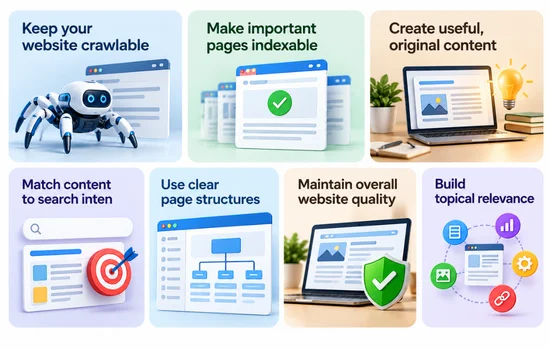
Yes. Traditional SEO still matters. AI search does not replace the foundations of SEO. It builds on the same web ecosystem Google uses to discover, understand and organise information.
Here is what businesses should continue focusing on:
- Keep your website crawlable: Search engines need to be able to access your important pages and content.
- Make important pages indexable: If a page is not available in Google’s index, it has limited opportunity to appear in search or contribute information to an AI-generated answer.
- Create useful, original content: Answer genuine customer questions instead of creating pages simply to include more keywords.
- Match content to search intent: Make sure each page clearly addresses what the person is actually looking for.
- Use clear page structures: Descriptive headings, logical sections and straightforward explanations make your content easier to understand.
- Maintain overall website quality: Your website should accurately explain your services, business information and areas of expertise.
- Build topical relevance: Create useful content around the subjects your business genuinely knows about rather than publishing unrelated articles for traffic.
Google has stated that its AI search experiences are built on existing Search systems and quality principles. That means businesses do not need to abandon SEO and start again for AI search.
7 Practical Ways to Get Your Business Found in Google AI Search
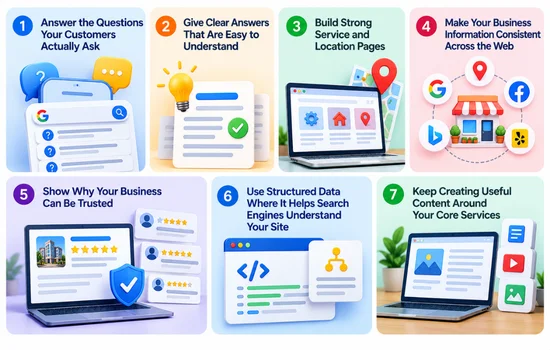
Here are seven practical ways to improve how your business is understood and discovered across Google’s AI-powered search experiences.
1. Answer the Questions Your Customers Actually Ask
Customers search for more than just a service name. They also ask questions about:
- Services: What does the service include?
- Location: Do you provide this service in my area?
- Problems: How can I solve a specific problem?
- Cost: How much does the service usually cost?
- Process: How does the service work?
- Timing: How long does it take or how often is it needed?
- Comparison: Which option is suitable for my situation?
Use questions from customer enquiries, conversations and search queries to find topics worth covering. You can answer related questions together instead of creating a separate page for every variation.
Example:
Instead of only targeting “commercial cleaning Auckland”, a cleaning company could answer:
“How often should an Auckland office be professionally cleaned?”
This gives the business a chance to provide useful information that directly matches what a potential customer wants to know.
2. Give Clear Answers That Are Easy to Understand
Clear content is easier for customers to scan and easier for search systems to understand. Keep each section focused on one question or idea.
- Give the answer early: Put the main answer close to the relevant heading instead of making readers search for it.
- Keep one main idea per section: Avoid combining several unrelated points under one heading.
- Use descriptive headings: Make headings specific enough to tell readers what they will find.
- Explain technical terms: Use simple language or briefly explain industry terminology when it is necessary.
- Use lists where useful: Break down steps, features or options when a list makes the information easier to follow.
- Remove unnecessary content: If a question can be answered clearly in a few sentences, do not stretch it into a long explanation.
The aim is not to write for an AI system. Write clear, useful information for people first, and make that information easy for search systems to understand too.
3. Build Strong Service and Location Pages
Your website should make it clear what you offer, who you serve and where you operate. This is especially useful for local businesses targeting searches that combine a service with a specific location.
Make sure your important service and location pages include:
- Dedicated service pages: Give each major service its own focused page.
- Clear service descriptions: Explain what you provide without vague or generic wording.
- Areas served: Clearly mention the cities, suburbs or regions where you operate.
- Business location: Make your business location easy to understand and verify.
- Who the service is for: Explain the types of customers or businesses that can benefit.
- Problems you solve: Address the specific needs that lead customers to search for your service.
- Useful supporting information: Include relevant details such as the process, FAQs, service requirements or what customers can expect.
- Consistent business details: Keep your business name, contact information and location details accurate across your website and other relevant profiles.
For example, instead of having one general “Cleaning Services” page, a cleaning company could have separate pages for Commercial Cleaning in Auckland, Office Cleaning in Auckland and other relevant services it actually provides.
The goal is to give Google and potential customers a clear understanding of what your business does, who it serves and where it operates.
4. Make Your Business Information Consistent Across the Web
Google needs to understand that the information it finds across different websites refers to the same business. Keeping your business details accurate and consistent helps create a clearer online presence.
Check that your key information matches across your website, Google Business Profile and relevant business profiles:
- Business name: Use the same official business name.
- Address: Keep your physical location accurate wherever it is listed.
- Phone number: Use a consistent contact number.
- Website: Make sure profiles point to the correct website.
- Services: Describe your main services consistently.
- Locations served: Clearly state the areas your business covers.
- Business description: Keep the core information about your business accurate.
- Google Business Profile: Keep your profile information updated.
- Relevant directories and profiles: Review important listings and correct outdated information.
The aim is not to create as many listings as possible. Accurate information on relevant platforms is more useful than having your business details scattered across dozens of low-quality directories.
5. Show Why Your Business Can Be Trusted
People want to know that the business behind a website is genuine, experienced and capable of delivering what it promises. Your website and online presence should make that evidence easy to find.
You can demonstrate credibility through:
- Genuine customer reviews: Show real feedback from customers rather than vague claims.
- Relevant experience: Explain your experience in the industry and the types of work you handle.
- Author information: Where appropriate, identify who created or reviewed expert content.
- Clear business information: Make it easy to find your contact details, location and information about the business.
- Case studies: Show real projects, the problem involved and how your business approached it.
- Original expertise: Share practical knowledge based on your actual experience.
- Credible references: Link to reliable sources when supporting factual or industry-specific claims.
- Relevant third-party mentions: Genuine coverage or references from relevant websites can provide additional context about your business.
The focus should be on showing real expertise, not manufacturing authority signals. Fake reviews, artificial mentions or unsupported claims can weaken trust rather than build it.
6. Use Structured Data Where It Helps Search Engines Understand Your Site
Structured data gives search engines additional information about what a page contains. It helps describe elements such as a business, service, organisation, product or other types of content in a format search systems can process.
For businesses, relevant structured data may include:
- LocalBusiness: Information about a local business and its details.
- Organisation: Information about the business or organisation.
- Service: Details about a specific service.
- Product: Information about products where relevant.
- Breadcrumb: Helps describe the relationship between pages on a website.
When using structured data, make sure:
- The information matches what is visible on the page.
- The markup accurately describes the content.
- Relevant schema types are used rather than adding unnecessary markup.
- Business details are kept accurate when they change.
Structured data can help search engines understand your content, but it is not a shortcut to appearing in Google AI Search. It should support a well-structured website and useful content rather than replace them.
Think of structured data as additional context for search engines, not a guarantee of greater visibility.
7. Keep Creating Useful Content Around Your Core Services
The focus should be on answering relevant questions and showing genuine knowledge in your industry.
You can create content such as:
- Supporting questions: Answer common questions related to your services.
- Buying guides: Help customers understand what to consider before choosing a service or product.
- Problem-solving articles: Explain practical solutions to common customer problems.
- Comparisons: Explain the differences between relevant options.
- Service FAQs: Address questions customers often ask before making an enquiry.
- Local topics: Cover useful information relevant to the areas you serve.
- Industry topics: Share knowledge connected to your actual experience and expertise.
- Updated content: Review older articles and update information when it becomes outdated.
You do not need to publish dozens of articles just to create more content. Build depth around the subjects your business genuinely knows, and make every article useful to the people you want to reach.
How to Check If Your Business Is Appearing in AI Search
You cannot judge your AI search visibility from a single search. A better approach is to test a range of questions that your potential customers are likely to ask.
Step 1: Create a list of customer questions
Think beyond your main keywords. Include questions about your services, location, pricing, problems, comparisons and buying decisions.
Step 2: Search those questions
Use the Google AI search features available to you and search each question naturally. Avoid changing the wording simply to make your business appear.
Step 3: Record what you find
For each search, check:
- Does your business appear?
- Is your website referenced?
- How is your business described?
- Which other businesses or websites are mentioned?
- Is the information about your business accurate?
Step 4: Look for patterns
One search does not give you a complete picture. Test different questions and review the results over time to identify where your business is being mentioned and where there may be gaps.
Google has also introduced Search Console reporting for generative AI features, giving website owners more insight into how their pages appear in AI search experiences. This provides another way to monitor visibility alongside your regular SEO data.
Simple AI Search Visibility Checklist for Your Business
Use this checklist to review the key areas that can support your business’s visibility in AI-powered search:
- Website can be crawled and indexed
- Important services have dedicated pages
- Service pages answer real customer questions
- Business location and contact details are consistent
- Google Business Profile is accurate and maintained
- Business information is consistent across relevant platforms
- Website demonstrates genuine knowledge and experience
- Customer reviews are authentic and relevant
- Relevant pages use appropriate structured data
- Content covers useful questions around your services
- AI search visibility is checked regularly
- SEO performance is monitored alongside AI search visibility
Working through these points gives you a practical starting point for improving how clearly your business is represented across search.
Conclusion
Getting your business found in Google AI Search is not about chasing a secret ranking trick or trying to optimise your website for machines instead of people. It starts with making your business easy to understand, useful to customers and supported by reliable information.
Your website should clearly explain what you offer, who you help and where you operate, while your wider online presence should reinforce that information with genuine evidence of your experience and expertise. As search continues to change, businesses that keep their content useful and their SEO foundations strong will be better prepared for new ways customers discover information.
If you are unsure how your website is performing in search, Revolution Hub can review your current SEO and search visibility to identify areas that could be improved.