

Should you invest your marketing budget in SEO or pay for Google Ads?
It is a common question for business owners, especially when every marketing dollar needs to have a clear purpose. Both can bring potential customers to your website, but they work in very different ways.
SEO focuses on building organic visibility in search results, while Google Ads gives you paid visibility for selected searches. One can take time to build, while the other can put your business in front of searchers much sooner. Neither is automatically the right choice for every business. Your goals, budget, competition and timeframe all matter. In this article, we will compare SEO and Google Ads, including how they work, their costs, expected timeframes, strengths and limitations, so you can better understand which approach fits your business.
What Is the Difference Between SEO and Google Ads?
SEO and Google Ads can both help people find your business through Google, but they work in different ways. Understanding this difference makes it easier to decide where your marketing budget may be better suited.
SEO
Search engine optimisation (SEO) involves improving your website so it can appear in Google’s organic search results. This can include creating useful content, improving technical SEO, building relevant service pages, earning links and making sure your website matches what people are searching for.
You do not pay Google for each click from an organic result. However, SEO usually takes time to build, and results depend on factors such as competition, website quality and the work being carried out.
Google Ads
Google Ads is a paid advertising platform that allows businesses to show ads for selected searches. You set a budget and can target specific keywords, locations and audiences. In many campaigns, you pay when someone clicks on your ad.
Unlike SEO, Google Ads can provide search visibility much sooner once a campaign is approved and running.
| SEO | Google Ads |
| Organic search visibility | Paid search visibility |
| Builds over time | Can start quickly |
| No payment for each organic click | Advertising spend applies |
| Focuses on longer-term visibility | Useful for immediate campaigns |
SEO vs Google Ads: How Do They Compare?
SEO and Google Ads differ in speed, cost, control and the type of visibility they provide. Looking at these factors can help you understand how each approach may fit into your marketing plans.
| Factor | SEO | Google Ads |
| Speed | Usually slower to build | Can generate visibility quickly |
| Cost model | Investment in SEO work and content | Advertising spend, plus management if required |
| Visibility | Appears in organic search results | Appears as paid search placements |
| Long-term value | Can continue generating organic traffic after work is completed | Paid visibility stops when campaigns stop |
| Control | Less control over exact search position | More control over targeting and budget |
| Testing | Can take longer to gather useful data | Campaigns can provide data relatively quickly |
| Best suited to | Building long-term search visibility | Immediate or campaign-focused demand |
This does not mean one approach is better for every business. A company launching a new service may value the speed and control of Google Ads, while another may be focused on building organic visibility over time. Your industry, competition, budget, website and business goals all need to be considered before choosing where to invest.
When Does SEO Make More Sense for a Business?
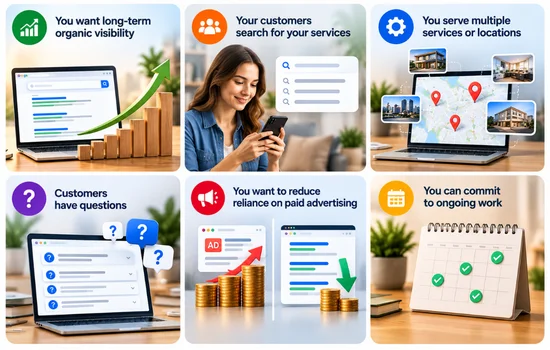
SEO may make sense when your business wants to build search visibility that can grow over time rather than relying only on paid placements. SEO services can help businesses improve their organic search presence through areas such as content, technical SEO and service pages.
SEO can be worth considering if:
- You want long-term organic visibility: You are prepared to invest in improving your search presence over time.
- Your customers search for your services: There is clear search demand around the products or services you offer.
- You serve multiple services or locations: Useful service and location pages can help your website target different relevant searches.
- Customers have questions: You can create useful content that answers genuine questions before people contact your business.
- You want to reduce reliance on paid advertising: Organic visibility can become another source of relevant website traffic.
- You can commit to ongoing work: SEO usually requires continued attention rather than a one-time setup.
For example, a local cleaning company could build visibility around searches such as cleaning services in Auckland, commercial cleaning, office cleaning and end-of-tenancy cleaning, while also answering common customer questions.
SEO can be useful when search visibility is part of your business’s longer-term growth plan.
When Can Google Ads Be Useful?

his can be particularly relevant for businesses promoting a new service, entering a competitive market or running a time-sensitive offer.
Google Ads may be worth considering if:
- You need visibility quickly: Paid search can put your business in front of relevant searchers soon after a campaign is approved and launched.
- You are launching something new: Ads can help promote a new service, product or special offer.
- You are entering a competitive market: Paid placements can provide another way to reach potential customers when organic competition is strong.
- You want to test demand: Campaign data can help you understand whether certain searches generate clicks and enquiries.
- You want location control: Campaigns can be targeted towards specific areas.
- You have a defined advertising budget: Daily or monthly budgets can help control spending.
- You offer high-value services: A small number of relevant enquiries may justify the advertising cost, depending on your margins and conversion rate.
For example, a business launching a new service could use Google Ads to generate search visibility while its organic SEO presence develops.
However, getting clicks is only part of the process. A useful landing page, clear offer and straightforward enquiry process are still needed to turn paid traffic into potential customers.
How Long Does SEO Take Compared With Google Ads?
The time it takes to see results is one of the biggest differences between SEO and Google Ads. Neither approach guarantees a particular outcome, but they work on different timelines.
SEO
SEO normally takes time because search rankings depend on factors such as your website, competition, content, technical setup and the searches you are targeting. New website or a business entering a competitive market may need more time to build visibility. Progress can be measured through changes in rankings, search impressions, organic traffic and enquiries.
Google Ads
Google Ads can start showing your business in relevant searches soon after your campaign is set up and approved. Early campaign data can also provide useful information about keywords, offers and landing pages. Results depend on factors such as budget, competition, targeting and campaign quality.
The key difference is that Google Ads can provide speed, while SEO focuses on building organic visibility over time. Speed and longevity are separate considerations when comparing the two.
Should You Choose SEO or Google Ads?
The right choice depends on what your business needs from its marketing and how quickly you need results. Instead of asking which channel is better, consider which approach fits your current situation.
SEO may fit if:
- Your goal is to build long-term organic search visibility.
- You can allow time for rankings and traffic to develop.
- Your customers regularly search for the services you provide.
- You have useful knowledge, information and expertise that can be developed into website content.
Google Ads may fit if:
- You need search visibility quickly.
- You want to test whether specific searches can generate enquiries.
- You are promoting a particular service, product or offer.
- You have a defined budget for paid advertising.
Both may make sense if:
- You want paid visibility while building organic traffic through SEO.
- Google Ads data can help identify useful keywords and customer demand.
- Different services or business goals require different marketing approaches.
The decision should come down to your goals, budget, timeframe, competition and how your customers search for your services.
How SEO and Google Ads Can Work Together
SEO and Google Ads do not always need to be treated as competing options. They can serve different purposes and work alongside each other as part of the same marketing strategy.
Google Ads can provide quicker data about which searches attract clicks and enquiries, while SEO can build organic visibility around valuable search terms over time. Paid campaigns can also support new services, seasonal offers or specific campaigns while organic content continues to develop.
For example, a business could use Google Ads to promote an important service while building a dedicated SEO-focused service page and supporting content around the same customer need. The paid campaign can help generate immediate visibility, while the SEO work focuses on longer-term organic traffic.
Both channels can also direct visitors to carefully planned landing pages, making it easier to measure what is generating enquiries.
Used together, SEO and Google Ads can support different goals within the same digital marketing strategy.
How to Decide What Your Business Needs
Before putting your budget into SEO, Google Ads or both, look at your current goals and resources. Ask yourself:
- How quickly do you need results?
Short-term campaign may require a different approach from a long-term growth plan. - How much can you consistently invest each month?
Consider both the marketing budget and the time available for ongoing work. - Are customers already searching for your services?
Search demand can influence which channel is worth exploring. - How competitive are your target keywords?
Competition can affect both organic rankings and advertising costs. - Which services generate the most value?
Focus your marketing efforts around services that matter most to the business. - Can your website convert visitors into enquiries?
Strong landing pages and clear calls to action are important for both channels. - Can you track enquiries and conversions?
Without tracking, it is difficult to understand whether your marketing spend is producing useful results.
The decision should come from your business goals, customer behaviour, budget and timeframe, rather than choosing a channel simply because it is popular.
Conclusion
SEO and Google Ads can both help your business reach people through Google, but they serve different marketing needs. SEO can support long-term organic visibility, while Google Ads can provide paid visibility when speed, targeting and campaign control are important.
For some businesses, one approach may be enough for their current goals. Others may benefit from using both as part of a wider marketing strategy. The key is to look at what you want to achieve, how your customers search, how much you can invest and how quickly you need results.
If you are unsure where to invest, Revolution Hub can review your website, search visibility and marketing goals to help you identify the approach that fits your business.