

Having a business website does not automatically mean people will find it on Google. You can have a professional-looking website, useful services and good information, yet still struggle to appear when potential customers are searching for what you offer.
Small businesses can make SEO mistakes without realising it. Some problems are technical, while others come from weak content, unclear website structure, poor local SEO or simply not maintaining the website over time. The good news is that SEO does not need to be complicated to get started.
In this article, we will look at 10 common small business SEO mistakes and what you should check instead. Understanding these issues can help you spot problems on your own website and identify where your search visibility may need improvement.
10 Common SEO Mistakes Small Businesses Make
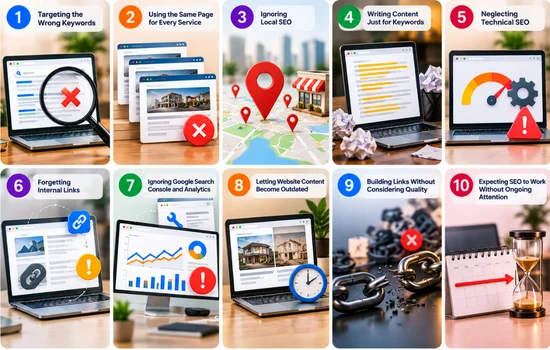
The following mistakes are common starting points to check when reviewing your small business website and its search visibility.
1. Targeting the Wrong Keywords
Choosing keywords only because they have a high search volume can bring visitors who are not looking for what your business actually provides. A keyword may attract plenty of searches but still have little value if it does not match your service or customer intent.
Common problems include:
- Targeting broad terms that do not clearly describe your service.
- Choosing phrases your customers are unlikely to search for.
- Ignoring specific service-related searches.
- Focusing only on search volume instead of relevance.
- Missing location-based searches when your business serves a specific area.
For example, a local cleaning company may get little value from targeting “cleaning” alone. More specific search such as “commercial cleaning Auckland” gives clearer information about the service and location being searched.
Your keyword choices should reflect what customers actually search for and what your business genuinely offers.
2. Using the Same Page for Every Service
Putting all your services on one general page can make it harder for both customers and search engines to understand exactly what your business offers. If an important service does not have its own relevant page, there may be fewer opportunities to provide detailed information around searches related to that service.
Common issues include:
- Listing every service on one general page.
- Not giving important services a dedicated page.
- Making customers search through a long page to find specific information.
- Missing opportunities to address different service-related searches.
- Creating pages that add little value simply to target keywords.
For example, a cleaning company offering commercial cleaning, house cleaning and lawn care could create a dedicated page for each core service, with useful information specific to that service.
Your website structure should reflect the services your customers are actually looking for.
3. Ignoring Local SEO
If your business serves a specific town, city or region, local SEO can help customers find you when they search for nearby services. Small businesses can miss these opportunities when their location information is incomplete, inconsistent or difficult to find.
Common issues include:
- Incomplete or inaccurate information on your Google Business Profile.
- Different business names, addresses or phone numbers across important platforms.
- Not clearly explaining the areas your business serves.
- Ignoring genuine customer reviews and feedback.
- Missing useful location information from relevant website pages.
- Creating location pages with little useful information simply to target different areas.
For example, a cleaning business serving Auckland should make it clear which areas it covers and provide useful information about its services rather than creating multiple location pages with almost identical content.
Local SEO should help both Google and potential customers understand where your business operates and what services you provide.
4. Writing Content Just for Keywords
Keywords help search engines understand what a page is about, but using them repeatedly does not automatically make the page better. Common SEO mistake is writing content around a keyword instead of writing something that is genuinely useful to the person searching.
Watch for problems such as:
- Repeating the same keyword unnecessarily.
- Forcing exact-match phrases into awkward sentences.
- Creating pages with very little useful information.
- Ignoring the questions customers actually want answered.
- Publishing AI-generated content without adding real business knowledge, experience or useful detail.
Better approach
Start with the customer’s question or problem. Explain the topic clearly, then use relevant keywords naturally where they fit.
Good SEO content should help the reader understand something, solve a problem or make a decision. If a keyword makes the writing sound unnatural, the sentence should be rewritten rather than forcing the phrase into it.
5. Neglecting Technical SEO
Website can have useful content and well-chosen keywords but still struggle in search if technical problems make it difficult for search engines to crawl or understand its pages. These issues can also affect the experience for visitors.
Common technical SEO problems include:
- Pages that are not being indexed properly.
- Broken internal or external links.
- Poor website structure that makes important pages difficult to find.
- Missing or incorrect canonical settings where they are needed.
- Slow or poorly performing pages.
- Mobile usability problems.
- Incorrect redirects after changing or removing URLs.
- Important pages accidentally blocked from search engines.
Practical check
Regularly review your website health and Google Search Console for indexing, performance and other technical issues. Do not assume everything is working simply because the website loads normally.
Sound technical foundation gives your content and keywords a better chance of being understood and discovered in search.
6. Forgetting Internal Links
Internal links connect one page of your website to another and make it easier for visitors to discover related information. Without them, important service or supporting pages can become isolated from the rest of your website.
Common issues include:
- Important pages having few or no internal links pointing to them.
- Service pages not linking to relevant supporting content.
- Blog posts missing natural links to related service pages.
- Using vague anchor text such as “click here” instead of descriptive wording.
- Adding links simply for SEO when they do not help the reader.
For example, a blog about commercial cleaning tips could naturally link to the business’s commercial cleaning service page for readers who want to learn more about the service.
Good internal linking should help visitors find useful information while giving search engines clearer context about how the pages on your website are connected.
7. Ignoring Google Search Console and Analytics
SEO decisions should not be based only on assumptions. Google Search Console and analytics data can show how people are finding your website, which pages they visit and where visibility may be changing.
Common problems include:
- Not checking search impressions and clicks.
- Ignoring the search queries bringing visitors to the website.
- Failing to identify pages that are losing visibility.
- Not checking for indexing issues in Search Console.
- Looking only at total website traffic.
- Not tracking enquiries, form submissions or other conversions.
Rise in traffic can look positive, but it does not always mean your website is attracting the right people. The more useful question is whether visitors are relevant and whether they are taking actions that matter to the business.
Regularly reviewing your data helps you identify what is working, what needs attention and where your SEO efforts should be focused.
8. Letting Website Content Become Outdated
SEO is not only about creating new pages and publishing fresh content. Existing pages also need attention as your business, services and customer needs change. Outdated information can make your website less useful and may lead visitors to incorrect information.
Check for issues such as:
- Old or inaccurate service information.
- Incorrect phone numbers, addresses or contact details.
- Outdated team information.
- Offers or pricing that are no longer current.
- Broken or outdated links.
- Older blog posts that no longer answer the question clearly.
- Business changes that have not been reflected on the website.
Review important pages regularly and update information when your business changes. SEO should include maintaining the content you already have, not just adding more.
Keeping existing pages accurate and useful helps ensure your website continues to reflect your business and serve your visitors properly.
9. Building Links Without Considering Quality
Backlinks can be part of an SEO strategy, but treating link building as a numbers game can lead to poor results. A large number of links is not necessarily useful if they come from irrelevant or low-quality sources.
Common problems include:
- Buying links simply to increase backlink numbers.
- Getting links from websites that have little connection to your business.
- Focusing on quantity rather than relevance.
- Using manipulative link-building tactics.
- Building links that have no genuine value or context.
Better approach is to focus on useful resources, relevant industry mentions, genuine business relationships and original content that other websites may find useful enough to reference.
The aim should not be to collect as many links as possible. Relevant, genuine references that make sense for your business can be more meaningful than a large collection of unrelated links.
10. Expecting SEO to Work Without Ongoing Attention
SEO is not something you can set up once and leave unchanged. Your website may change, competitors may improve their search presence and the way people search for services can shift over time. These changes can affect your visibility even when you have not changed your SEO strategy.
Ongoing SEO may involve:
- Reviewing rankings and organic traffic.
- Updating content when information changes.
- Checking for new technical problems.
- Improving pages that are not performing as expected.
- Monitoring changes in customer search behaviour.
- Keeping an eye on relevant competitors.
- Connecting SEO work to actual business goals and enquiries.
Regular attention does not mean constantly changing your website. It means reviewing what is happening, identifying genuine issues and making improvements when they are needed.
SEO should be treated as an ongoing process of improving, monitoring and responding to change.
How to Check If Your Website Has These SEO Problems
After identifying these common SEO mistakes, the next step is to check whether any of them are affecting your own website. Basic review can help you find issues that may otherwise go unnoticed.
- Check whether your important pages are indexed by Google.
- Review your main service pages and make sure they provide useful information.
- Check that your Google Business Profile is complete and accurate.
- Review page titles, headings and other important on-page elements.
- Look for broken links and outdated information.
- Test your website on mobile devices.
- Review internal links between related pages.
- Check Google Search Console for search and indexing data.
- See whether your important pages are receiving organic traffic.
- Check whether website visitors are completing enquiries or other important actions.
If you are unsure where to start or need help identifying SEO issues, Revolution Hub’s SEO services can help you review your website and identify areas that may need attention.
Conclusion
Good SEO does not have to start with complicated tactics. For a small business, fixing basic issues with keywords, service pages, technical health, local visibility and website content can create a stronger foundation for search visibility.
The goal should also be bigger than rankings alone. Your SEO should help the right people find your business, understand what you offer and take the next step towards becoming a customer. Regular monitoring and updates can help keep that work on track as your business and search behaviour change.
If you are unsure which SEO issues are affecting your website, Revolution Hub can review your current search visibility and identify where improvements may be needed.