
Your website might not be broken. It might simply be holding your business back. It can still be online, load correctly and bring in visitors while making it harder for people to understand your business, find what they need or get in touch. An outdated layout, poor mobile experience, confusing navigation, slow pages or weak calls to action can all affect how visitors interact with your website.
So, how do you know when your existing website needs more than a few small updates? A redesign is not simply about making your website look newer or following the latest design trends. It should address real problems and help your website work better for both your visitors and your business. Here are 10 signs that it may be time to reconsider how your website is designed, structured and presented.
10 Signs Your Business Website Needs a Redesign
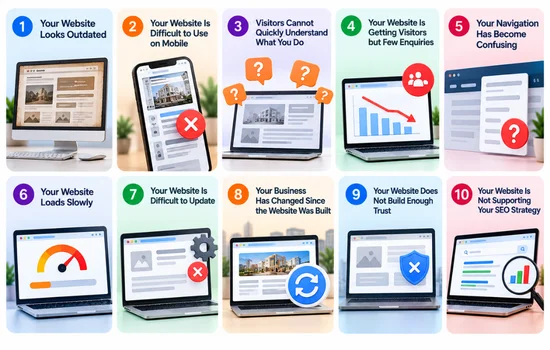
Website can develop problems gradually as your business, customers and online needs change. These signs can help you identify whether your current website needs a few improvements or a more complete redesign.
1. Your Website Looks Outdated
Visitors form an impression of a business from its website before they ever make contact. An old layout, inconsistent fonts or colours, dated imagery and design elements that no longer match your brand can make the website feel neglected.
That does not mean your website needs a redesign every time a new design trend appears. The bigger question is whether the design still represents your business properly.
Look for signs such as:
- Old visual design: The website looks noticeably dated compared with current business websites.
- Inconsistent branding: Fonts, colours and visual elements do not work together.
- Poor-quality imagery: Images look blurry, stretched or no longer represent your business.
- Outdated layouts: Important information is difficult to find or presented in an old-fashioned structure.
- Brand changes: Your business has evolved, but the website still reflects the old identity.
If the website no longer matches the quality or direction of your business, a redesign may be worth considering.
2. Your Website Is Difficult to Use on Mobile
A website that looks good on a desktop can still create problems on a phone. If visitors have to zoom in, scroll sideways or struggle to tap buttons, they may leave before finding the information they need.
Check for issues such as:
- Small or difficult-to-read text
- Buttons that are hard to tap
- Horizontal scrolling
- Menus that are difficult to open or navigate
- Images or sections that do not fit the screen
- Forms that are frustrating to complete on a smaller device
Check this yourself
Open your website on your phone and try to find your main service, contact details and enquiry form without zooming in. If any of these tasks feels difficult, your mobile experience may need attention.
A good mobile experience should make it easy for visitors to browse, understand your services and take the next step.
3. Visitors Cannot Quickly Understand What You Do
A visitor should not have to read through several sections to work out what your business does. Your homepage should communicate the essentials quickly and make the next step obvious.
Check whether visitors can easily understand:
- What you offer: Are your main products or services clear?
- Who you serve: Is your target customer obvious?
- Where you operate: Can visitors quickly see your service area?
- Why choose you: Is there a clear reason to consider your business?
- What to do next: Is there an obvious action, such as requesting a quote, booking a service or contacting you?
Try the 5-second test
Ask someone who does not know your business to look at your homepage for five seconds. Then ask them what your business does, who it serves and what they would do next.
If they cannot answer these questions, the issue may not be the visual design. Your website’s messaging and structure may need to be reconsidered.
4. Your Website Is Getting Visitors but Few Enquiries
Getting visitors to your website is useful, but traffic alone does not mean the website is generating business. If people arrive, browse and leave without contacting you, there may be a problem with the journey from visitor to enquiry.
Look for these signs:
- Weak calls to action: Visitors are unsure whether to call, request a quote or make an enquiry.
- Confusing enquiry journey: Contacting the business takes too many steps.
- Important information is buried: Key service details, pricing information or contact options are difficult to find.
- Limited trust signals: Visitors do not see enough genuine information to feel comfortable making contact.
- Poor service-page structure: Pages do not clearly explain the service or guide visitors towards the next step.
- No clear next action: Visitors finish reading a page without knowing what to do next.
However, a low enquiry rate is not always a website problem. Traffic quality, pricing, competition and the strength of your offer can also affect enquiries. A proper review should consider these factors before deciding that a redesign is needed.
5. Your Navigation Has Become Confusing
As a website grows, new pages can gradually make the navigation harder to use. Too many menu items, unclear page names or important information buried several clicks deep can make it difficult for visitors to find what they need.
Look for signs such as:
- Too many menu items: Visitors have too many choices to work through.
- Hidden important pages: Key services or contact information are difficult to find.
- Unclear page names: Menu labels do not clearly explain what each page contains.
- Duplicate or unnecessary pages: Similar pages make the structure harder to understand.
- No clear path to an enquiry: Visitors can find information but cannot easily see what to do next.
Check these three journeys
Try using your website as a new visitor and see how easily you can:
- Find a service
- Learn about the business
- Make an enquiry
If any of these journeys requires too many clicks or feels confusing, your website structure may need attention.
6. Your Website Loads Slowly
Slow website can make it harder for visitors to browse your pages, find information and complete an enquiry. Large images, unnecessary scripts, excessive plugins, heavy animations and poorly optimised page elements can all contribute to slower loading times.
Check for common causes
- Large images: Images that are not properly compressed or sized for the page.
- Too many plugins or scripts: Unnecessary features adding extra resources to the website.
- Heavy animations: Effects that add visual weight without improving the user experience.
- Poor hosting: Hosting limitations affecting website performance.
- Unoptimised elements: Page builders, videos or other content that have not been properly optimised.
Slow website does not automatically mean you need a redesign. Sometimes image optimisation, removing unnecessary features or improving hosting can solve the problem. If performance issues are linked to an outdated website structure or technical setup, however, a redesign may be worth considering.
7. Your Website Is Difficult to Update
Your business changes over time, and your website should be able to keep up. If updating a service, replacing an image or changing team information requires technical help every time, the website may be limiting you.
Look for signs such as:
- Outdated service information: Important details are no longer accurate.
- Old team details: Staff or contact information has not been updated.
- Old images: Photos no longer represent the business.
- Difficult editing: Simple content changes are unnecessarily complicated.
- Developer dependence: You need outside help for basic updates.
- Limited website setup: The current platform makes future improvements difficult.
Website should be practical to manage as your business grows. If keeping basic information current feels like a technical project every time, it may be worth reconsidering the website’s setup.
8. Your Business Has Changed Since the Website Was Built
Your website should represent the business you operate today, not the business you were several years ago. If your services, customers, locations or brand have changed, an old website may no longer communicate what your business actually offers.
| Old Website | Current Business |
| Old services | New service offering |
| Old audience | Current target customers |
| Old locations | Current service areas |
| Old branding | Current brand identity |
| Old positioning | Current business direction |
| Old offers | Current pricing or packages |
You may also have expanded into new locations, changed your business model or repositioned your services. These changes can make an older website feel disconnected from the business behind it.
If a customer visited your website today, would they recognise the business you are running now? If the answer is no, a website redesign can provide an opportunity to bring your content, structure and visual identity in line with the current business.
9. Your Website Does Not Build Enough Trust
Visitors may be interested in your services but still hesitate to make contact if your website does not provide enough information about the business behind them. Trust comes from giving people genuine reasons to feel confident about their decision.
Look for missing or weak areas such as:
- Customer reviews and testimonials: Real feedback can show what previous customers experienced.
- Case studies: Relevant examples can demonstrate the type of work you have completed.
- Business information: Explain who you are, what you do and where you operate.
- Team information: Introduce the people behind the business where it is relevant.
- Contact details: Make it easy for visitors to see how they can reach you.
- Credentials: Include relevant qualifications, memberships or certifications where applicable.
- Clear service information: Explain what customers can expect before they enquire.
- Professional imagery: Use genuine, relevant images that represent the business accurately.
These elements should not be added simply to make the website look more credible. They should provide real information that helps potential customers decide whether your business is right for them.
10. Your Website Is Not Supporting Your SEO Strategy
A website can look good and still make SEO harder than it needs to be. If important services do not have dedicated pages, headings are unclear or the site structure makes key information difficult to find, your website may not be supporting your search visibility effectively.
Check for issues such as:
- Missing service pages: Important services do not have their own focused pages.
- Unclear titles and headings: Page topics are not obvious to visitors or search engines.
- Content mismatch: Pages do not properly address what people are searching for.
- Weak internal linking: Related pages are not connected in a useful way.
- Difficult site structure: Important content is buried or difficult to reach.
- Outdated content: Existing pages no longer provide accurate or useful information.
- Technical SEO issues: Problems with crawling, indexing or page performance may need attention.
- Missing location pages: Relevant service areas are not clearly covered where location-based pages genuinely make sense.
Redesign is also a good time to review your SEO, but do not delete useful pages or change URLs without a plan. SEO should be considered before redevelopment begins so valuable visibility is not unnecessarily lost.
What Should You Check Before Starting a Website Redesign?
Before starting a website redesign, take time to understand what is working, what needs improvement and what the new website should achieve.
- Review what is working well: Keep useful content, features and pages that already perform well.
- Check which pages bring traffic: Identify pages receiving organic search traffic and avoid removing them without a plan.
- Find which pages generate enquiries: Understand which pages contribute to calls, forms or other enquiries.
- Identify your key services: Make sure your most important services have the right visibility and page structure.
- Define your target audience: Be clear about who the new website needs to speak to.
- Understand customer questions: List the information visitors need before they feel ready to contact you.
- Review your URLs: Identify important URLs that should be retained or redirected if changed.
- Plan page consolidation: Decide whether similar or outdated pages should be combined.
- Protect SEO performance: Record important rankings, traffic and pages before making major changes.
- Check the mobile experience: Note areas where navigation, forms, content or layouts need improvement.
- Set clear business goals: Decide what the redesigned website should help you achieve, such as more enquiries, better visibility or clearer service presentation.
Conclusion
Website redesign is not about making your website look newer simply because it has been online for a few years. The real purpose is to fix problems, improve the user experience and make sure your website still supports where your business is heading.
The better question is not “Is my website old?” but “Is my current website still helping my business achieve its goals?” If your website is difficult to use, no longer reflects your business, limits your SEO or struggles to turn visitors into enquiries, it may be time to make changes.
At Revolution Hub, we can review your existing website and help identify whether it needs targeted improvements or a broader redesign. Contact us to discuss what your website needs next.